Amway Lead Generation: How Distributors Get Customers in 2026
Leads are the business — in Amway or anywhere else. Here's the uncomfortable truth about how most distributors chase them, and the system the ones who grow actually run.

Amway distributors get leads two ways: the old way (warm contacts — friends, family, coworkers) and the 2026 way (content that attracts, a landing page that captures emails, automated follow-up that nurtures). The second way scales; the first runs out — so build the system.
Lead generation that works
Our view, from building automated lead systems. Compliance note: always check Amway's current Digital Communications Standards.
Why the warm list fails
Verdict The classic advice — "make a list of 100 people you know" — isn't wrong because people are lazy. It's wrong because it's a finite resource treated as a business plan. A list of 100 has an end. A system doesn't.
Every new Amway IBO hears some version of the same onboarding: write down everyone you know, start calling. It works exactly once — and then the distributor faces the real problem: where does the 101st prospect come from?
Most never answer that question. They either quit or start pitching strangers awkwardly, which burns social capital without building a pipeline. The issue was never effort. It was architecture.
The system: attract → capture → follow up
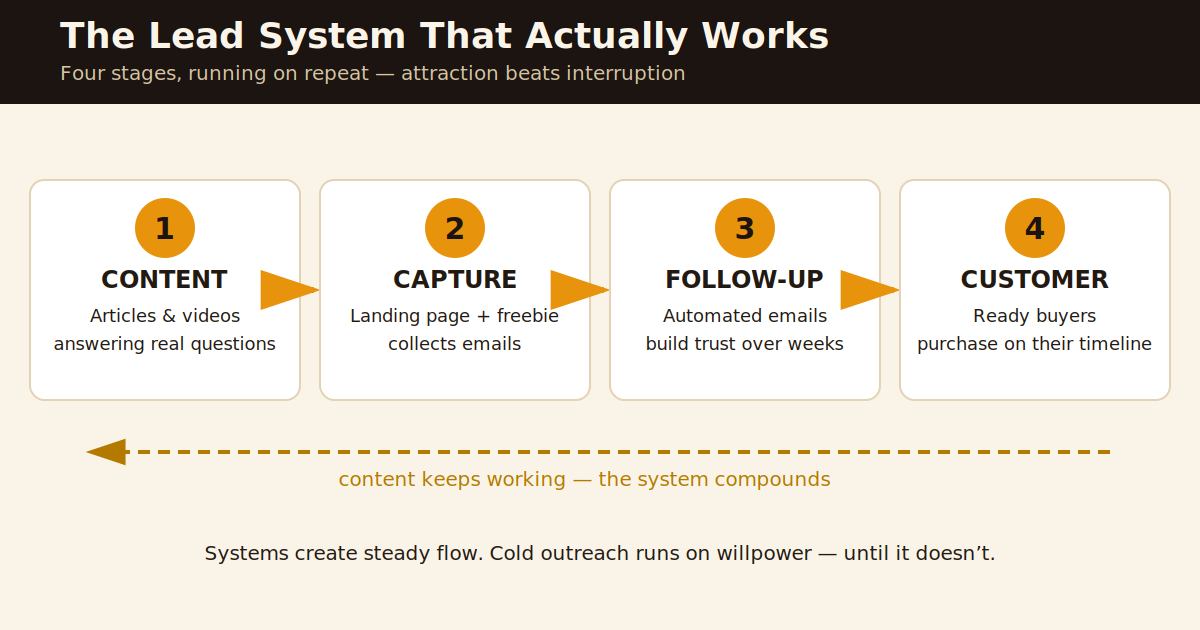
Three parts, each simple, each doing a job the warm list can't:
- Attract with useful content. Answer the questions prospects are already asking: product comparisons, "how does this work" explainers, honest reviews. One useful article or video a week. This is a long game that compounds — the piece you publish today still brings prospects next year.
- Capture with a lead magnet. Offer something genuinely useful — a product guide, a "which products fit your goals" quiz, a short training — in exchange for an email address. A simple landing page does this job; we build ours on systeme.io (free tier handles it, and that's our affiliate link, disclosed).
- Follow up automatically. An email sequence that educates over weeks: product stories, how-tos, invitations to talk. Set it once. Every new subscriber gets the full sequence, whether you met them Tuesday or they found you at 2am.
Watch out Amway's Rules of Conduct restrict broadcast-style solicitation — mass emails, telemarketing-style blasts, and certain online advertising methods have limits. Educational content and permission-based email (people who opted in) are the compliant lane. Read the current Digital Communications Standards before you launch anything.
What to actually publish
Content ideas mapped to what prospects search for:
- Product education: "Nutrilite vs. drugstore multivitamins: what's actually different" — attracts buyers, not just recruits.
- Honest comparisons: "Amway vs. [competitor]" — captures commercial-intent traffic.
- How-tos: "How to read any compensation plan in 10 minutes" — builds trust with skeptics.
- Behind the scenes: your real routine, real numbers, real lessons — the content no corporate brochure can make.
The pattern: teach, don't pitch. Every piece ends with one quiet invitation — the lead magnet — never a hard close. Our view: the distributors who teach outsell the distributors who pitch, because trust compounds faster than pressure.
The math of the system
No income claims here — just arithmetic about the system, not earnings. One useful piece a week is 52 doors a year. Each door works around the clock, never gets tired, and never pitches anyone awkwardly at a holiday dinner. Compare that to a warm list of 100 that you burn through once. The system isn't a shortcut; it's the only approach with no ceiling.
And here's the part most relevant to Amway specifically: the company's own 2025 income disclosure shows modest typical earnings before accounting for the cost of customer acquisition done the hard way. A system that brings prospects to you instead of you chasing them is the highest-leverage change a distributor can make.
How we researched this
Lead-system design from our own automation practice (we build these for a living). Amway compliance notes from the company's published Rules of Conduct and Business Starter Guide (assets.contentstack.io, checked October 2026) — summarized, not quoted; verify current standards before acting. No earnings claims made or implied.
Frequently asked questions
How do Amway distributors get leads?
Traditionally through warm contacts. The modern approach is systems: content that attracts prospects, a landing page capturing emails, and automated follow-up nurturing them. The distributors growing in 2026 run the second playbook.
Can you advertise your Amway business online?
Amway's rules restrict mass advertising and certain online solicitation under the Rules of Conduct. Educational content marketing generally fits within compliant personal branding, but check the current Digital Communications Standards before running any campaign.
What is the best lead magnet for network marketing?
One that solves a specific problem: a product guide, a quiz, a short training. Generic "join my team" pitches convert poorly; useful free resources convert well.
How many follow-ups does it take to get a customer?
Prospects rarely buy on the first touch — which is exactly why systematic follow-up matters. An automated email sequence follows up consistently without the awkwardness of manual chasing.
Want the system behind this?
The MLM Lead System Starter Kit is free: how distributors capture leads, follow up automatically, and keep conversations moving — the system most never get.
Free · double opt-in · unsubscribe anytime.