Can You Make Money With Amway? An Honest Look
This is the question everyone actually wants answered. So let's answer it with the company's own numbers, the costs nobody puts on the registration page, and what we believe is the systems gap that decides more outcomes than effort alone.

Yes, some people make money with Amway — and the company's own 2025 disclosure puts typical results in perspective: $750/year average across all U.S. IBOs before expenses ($1,161 for those with any sales). Whether it's "worth it" depends entirely on your goal and your systems.
The opportunity, honestly
Earnings figures: Amway 2025 U.S. Income Disclosure, checked October 2026. "Our view" sections are our argument, labeled as such.
The math, from Amway's own disclosure
Verdict Forget the testimonials — in either direction. The company's own income disclosure is the only earnings document that matters, and Amway publishes a clear one. Here's what it says.
Amway's 2025 U.S. Income Disclosure reports, for U.S. IBOs at Founders Platinum level and below:
| Group | Average annual earnings |
|---|---|
| All IBOs (incl. those with no sales) | $750 |
| IBOs reporting any product sales | $1,161 |
Source: Amway 2025 U.S. Income Disclosure (amway.com), covering earnings for the year ending December 31, 2025 — checked October 2026. Figures are before expenses.
Read that carefully: before expenses. Products you buy, tools, event tickets, travel — none of that is subtracted. And the $750 figure includes IBOs who never sold anything, which drags the average down; the $1,161 figure is the more useful one, and it's still modest. These are not our numbers or a critic's numbers. They're Amway's.
Why the math is hard (it's not just effort)
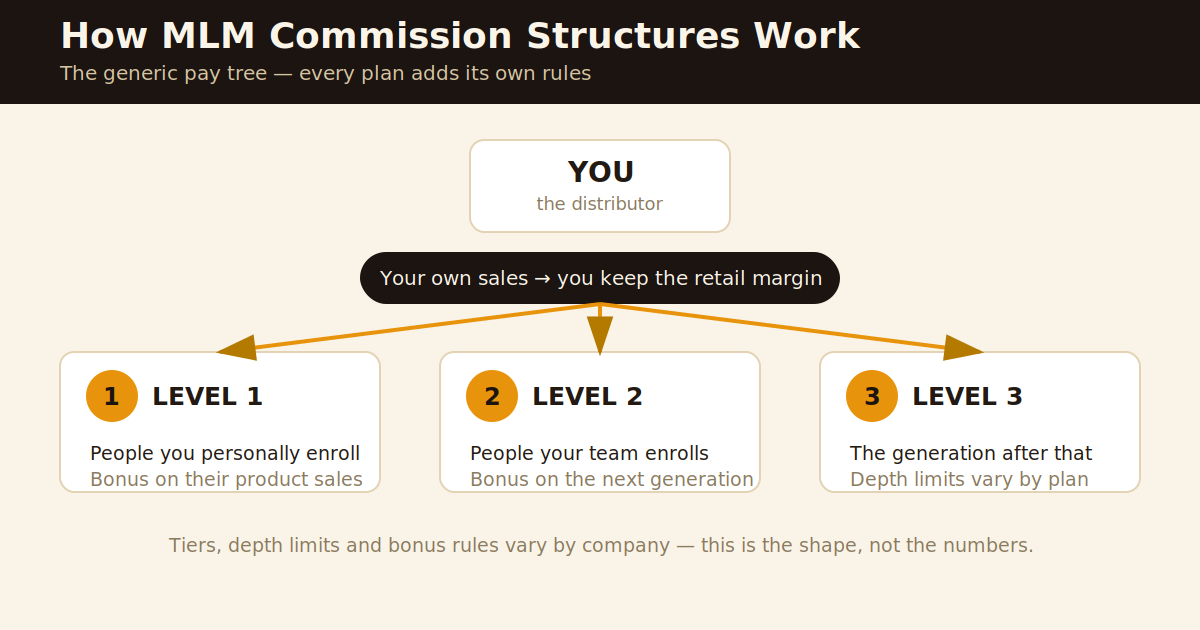
Three structural realities shape every IBO's outcome:
- Volume thresholds. The plan pays bonuses on monthly volume — in practice, active IBOs buy product monthly to stay qualified. That's a real recurring cost.
- Retail pricing. Amway products are premium-priced versus mass retail. Selling at a margin means finding customers who value the products enough to pay it — a genuine sales job.
- The team-building curve. Meaningful bonus income requires a productive team, which takes years to build and constant recruiting to maintain.
Watch out The 2026 FTC/Washington proposed settlement would require IBOs to resell at least 70% of what they purchase monthly. If finalized, the "buy to qualify" pattern gets much harder to sustain — watch this space before you build plans on the old math.
Our view: it's a systems problem
Here's our argument, labeled as ours: most Amway IBOs don't fail from lack of effort. They fail from lack of systems. Consider what a new IBO typically gets: a list of warm contacts, some product training, and encouragement. Consider what they don't get:
- A real lead flow beyond friends and family
- Follow-up automation — our view: few prospects buy on the first conversation; the sale is usually made in the follow-up, and almost nobody follows up systematically by hand
- An onboarding system for new team members (so recruits don't stall in week two)
- A content engine that attracts prospects instead of chasing them
Tools don't override the underlying math — we say that plainly, because it's true. But between two IBOs with the same effort, the one with systems is better equipped to turn effort into results. That's the gap this whole section of our site exists to close.
The minimum viable system
If we were equipping an Amway IBO tomorrow, the stack would be:
- Lead capture: a simple landing page offering something useful (a product guide, a quiz) in exchange for an email. We build these on systeme.io — free tier covers the basics, and yes, that's our affiliate link, disclosed.
- Follow-up: an email sequence that nurtures prospects automatically — product education, stories, invitations. Set once, runs forever.
- Onboarding: a welcome sequence for every new team member: what to do in week one, how the plan actually pays, where to get help.
- Content: one useful piece a week that answers the questions prospects are already googling — which is exactly the playbook this site runs on.
None of this is magic. It's just the infrastructure that turns sporadic effort into output that builds on itself — and it's what most distributors are never given.
How we researched this
Earnings figures: Amway's 2025 U.S. Income Disclosure (amway.com), checked October 2026. Cost and plan mechanics: Amway's published registration and insider pages. Regulatory context: ConsumerAffairs reporting (September 24, 2026) on the FTC/Washington complaint and proposed settlement. "Our view" sections are our argument, not researched fact.
Frequently asked questions
What is the average Amway IBO income?
Amway's 2025 U.S. Income Disclosure reports $750/year average across all U.S. IBOs at Founders Platinum and below before expenses (including those with no sales), and $1,161/year for those reporting any product sales. Company-published, before expenses.
Where can I read Amway's income disclosure myself?
Amway publishes it on amway.com — see the link in our Sources section below. It's the 2025 U.S. document covering earnings for the year ending December 31, 2025. Always read the company's own document before deciding — not a summary, including ours.
Do Amway IBOs have to buy products every month?
Amway states there are no required purchases. But the compensation plan has monthly volume thresholds for bonuses, so active IBOs typically do purchase monthly. Check the current plan document for exact thresholds.
Why do most Amway distributors fail?
Our view: it's mostly a systems gap — no lead flow beyond warm contacts, no follow-up automation, no onboarding system — compounded by genuinely hard math (modest typical earnings against real ongoing costs). Effort without infrastructure rarely compounds.
Is the Amway opportunity worth it in 2026?
Depends on the goal. For product enthusiasts wanting a small side income, the math can work. As an income replacement, the company's own disclosure suggests planning for modest results — and the 2026 regulatory proposal adds uncertainty worth watching.
Want the system behind this?
The MLM Lead System Starter Kit is free: how distributors capture leads, follow up automatically, and keep conversations moving — the system most never get.
Free · double opt-in · unsubscribe anytime.