Is Amway Legit or a Scam? How the Business Model Actually Works
"Is Amway legit?" is one of the most-searched questions in network marketing. The useful version of the question isn't a yes/no — it's how does the model actually work, what does the law say, and what do the numbers show? That's what this article does. No hype, no hit piece.

Amway is a multi-level marketing company — the FTC ruled in 1979 it was not an illegal pyramid scheme. IBOs earn through retail margins and team-sales bonuses, not recruiting fees. The real question is economic: Amway's 2025 income disclosure reports average annual earnings of $750 before expenses (Founders Platinum and below). Use the Koscot test below to evaluate any plan.
Amway, evaluated honestly
From the FTC's published decisions, Amway's 2025 U.S. Income Disclosure, and September 2026 press reporting. Sources linked at the bottom.
The question behind the question
When someone asks "is Amway a scam," they're usually asking one of three things:
- Is it legal? Could I join without walking into an illegal operation?
- Is it honest? Are the income claims I heard from a recruiter real?
- Is it worth it? Will I make money if I join?
Those are three different questions with three different answers. We'll take them in order — and along the way, you'll learn how to evaluate any network marketing company, not just Amway. That's the point of this article.
How Amway's business model actually works
Amway is a multi-level marketing (MLM) company: it sells products through Independent Business Owners (IBOs) who earn in two ways — retail margin on products they sell to customers, and bonuses based on the sales volume they and their sponsored teams generate. The company ships products directly; IBOs don't need to carry inventory. (We cover the full company breakdown in Amway: What It Is and How It Works.)
Here's the money flow, stripped to the essentials:
- Products — roughly 350 health, beauty, and home products, led by Nutrilite, Artistry, and XS.
- Retail sales — an IBO buys at the IBO price, sells at the customer price, and keeps the margin.
- Team sales — when IBOs the person sponsored also sell products, monthly performance bonuses are calculated on that combined volume.
- Compensation is for sales, not sign-ups — Amway's own disclosure states IBOs are compensated for product sales, not for enrollment or renewal of other IBOs.
The key structural question — and the one the law cares about — is whether those bonuses are genuinely tied to products reaching real users, or whether they're really rewards for recruiting people. That's exactly what the FTC's test measures.
What a pyramid scheme legally is: the Koscot test, in plain English
The FTC's definition comes from a 1975 case against Koscot Interplanetary, a cosmetics company that charged people thousands to join and paid them for recruiting more participants — not for selling cosmetics. The court created what's now called the Koscot test. In plain English, a pyramid scheme has all four of these elements:
- You pay money to the company to participate.
- You get the right to sell a product.
- You get the right to earn rewards for recruiting other people into the program.
- Those recruitment rewards are unrelated to the sale of products to actual users.
That fourth element is the hinge. If the money mostly flows from recruiting fees rather than products bought by people who use them, it's a pyramid scheme under this test. All four elements must be present. If any one is missing, the legal definition isn't met.
One current nuance worth knowing: in a March 2024 staff letter to the Direct Selling Association, the FTC reiterated that there's no simple percentage-based "primary source" test — courts look at whether a compensation plan incentivizes recruiting and whether participants buy or consume products in order to qualify for rewards (reported by Direct Selling News, March 2024). The focus is on the plan's incentives, not a magic ratio.
Why Amway passed in 1979 — and what that ruling really said
In In re Amway Corp. (93 F.T.C. 618, final order May 1979), the FTC ruled that Amway was not an illegal pyramid scheme. The decision said the Amway plan was "significantly different" from the pyramid plans condemned in Koscot, because Amway built safeguards tying rewards to actual retail selling:
- No entry fee just for the right to recruit — no "headhunting fee."
- Product sales were a precondition for receiving the performance bonus.
- Inventory buyback — excessive inventory had to be bought back, preventing "inventory loading."
- The 70% rule — distributors had to resell at least 70% of the product they bought in a month to qualify for bonuses.
- The 10-customer rule — to earn bonuses on downline volume, a sponsoring distributor had to make retail sales to at least ten different customers that month.
The FTC found these rules were actually enforced and served to prevent inventory loading and encourage retailing. Those "Amway Rules" became the industry's blueprint for a legal MLM plan.
What people forget The same 1979 decision also found Amway guilty of price fixing and of misrepresenting potential income — the FTC ordered the company to disclose actual average earnings figures in its recruiting materials. The ruling was a legal win on the pyramid question and a loss on the honesty-in-recruiting question. Both parts matter.
Your evaluation framework: testing any MLM
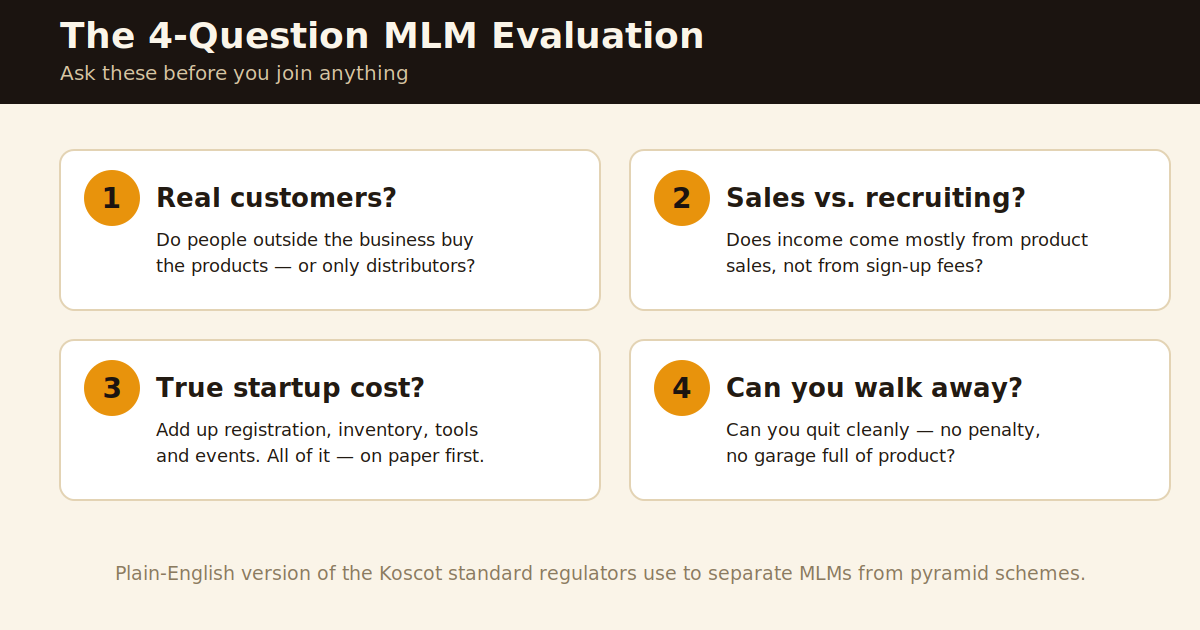
Here's the framework we recommend — apply it to Amway or anything else:
- Run the Koscot test. Are rewards tied to products reaching real users, or to recruiting? Read the compensation plan, not the recruiting presentation.
- Read the income disclosure. Every reputable MLM publishes one. It's the only honest earnings data that exists for the company.
- Price-check the products. If nobody would buy them without the business attached, the "business" is recruiting.
- Map the real costs. Registration is the smallest number. Add products, tools, events, travel, and time.
- Check the regulator record. Has the FTC or a state attorney general acted against the company? Settlements are public.
The regulatory picture today
Regulators never stopped watching Amway after 1979. In September 2026, the FTC and Washington state filed a complaint and proposed a $225 million settlement over what regulators described as deceptive recruitment practices. Under the proposed order's terms, Amway would have to rebuild its incentive structure: IBOs reselling at least 70% of what they buy each month, recruiters earning less when their downline buys product but doesn't sell it, sales reported with customer receipts, an independent auditor reviewing the books, and a ban on charging new recruits for training or services during their first year (reported by Human Resources Director America, September 2026).
Two honest notes: nearly all of the $225 million is earmarked to repay affected recruits, and Amway disputes the agencies' characterization of its sales data. A proposed settlement is not a finding that the company is a pyramid scheme — but it does mean the recruiting incentives and income claims are under serious, ongoing regulatory pressure. Anyone joining in 2026 should understand the rules may keep shifting.
The honest economics: what Amway's own disclosure shows
Amway publishes a U.S. Income Disclosure every year. The 2025 U.S. Income Disclosure (published January 2026) reports:
- Average annual earnings for all U.S. IBOs at Founders Platinum and below: $750 before expenses — and that average includes IBOs who reported no product sales at all.
- Average annual earnings for IBOs who reported any product sales (personally or via their team): $1,161 before expenses.
- The disclosure is explicit: IBOs earn only by selling Amway products to customers — on their own or with a sales team.
Read that slowly. $750 a year — before expenses, before the products you bought yourself, before events and tools. A 2026 independent review of the same disclosure (Make That Sea Change, updated September 2026) reports that 38% of U.S. IBOs had no reported sales, sponsored no one, and received no Amway payments — while 59% received at least one payment in a month for product sales during 2025.
We cite this because it's the company's own data. This is the math every prospect should see before a recruiter's success stories do their work. Our full opportunity breakdown is at Can You Make Money With Amway?.
Seven questions to ask before joining Amway — or anything
- Where does the money come from? Product sales to real customers, or fees from new sign-ups? (Run the Koscot test.)
- What will this cost me per month, honestly? Not just registration — products, tools, event tickets, travel. Write it down.
- Can someone succeed here without recruiting? If the plan only makes sense with a team under you, recalculate.
- What does the income disclosure show? Read it yourself. Never join off a recruiter's story alone.
- Can I return unsold product? Get the buyback policy in writing.
- What happens if I quit? Contract terms, refund window, what you keep.
- Would I buy these products at these prices if there were no business attached? If the answer is no, you're not buying a business — you're buying a dream.
Our view We believe most distributors fail not for lack of effort but for lack of systems — follow-up, lead flow, and honest math before they start. That's the gap we equip people to close. But the honest caveat: no system overrides the underlying economics of a compensation plan. Run the numbers above first. Systems multiply what the math allows; they don't rewrite it.
Evaluating an opportunity? Start with the system.
We put together a free starter kit — the MLM Lead System Starter Kit: how distributors capture leads, follow up automatically, and keep conversations moving — the system most never get. No pitch — just the system.
How we researched this
Facts verified October 13, 2026 against the FTC's published decisions (In re Koscot Interplanetary, Inc., 86 F.T.C. 1106 (1975); In re Amway Corp., 93 F.T.C. 618 (1979)), the FTC's March 2024 staff letter to the Direct Selling Association, Amway's 2025 U.S. Income Disclosure (published January 2026), Direct Selling News reporting (March 2024), and Human Resources Director America's September 2026 reporting on the proposed FTC settlement. We are not lawyers; this is educational, not legal advice. We accept no paid placements.
Frequently asked questions
Is Amway a pyramid scheme?
In 1979, the FTC ruled that Amway was not an illegal pyramid scheme (In re Amway Corp., 93 F.T.C. 618) — the landmark case for direct selling. In 2026, the FTC and Washington state filed a complaint and proposed a $225 million settlement over recruitment practices, showing regulators still scrutinize the model. Legal does not automatically mean lucrative — read the income disclosure before deciding.
What is the FTC's Koscot test?
From FTC v. Koscot Interplanetary (1975): a pyramid scheme exists when participants pay money to the company and get (1) the right to sell a product plus (2) the right to earn rewards for recruiting others — where those rewards are unrelated to the sale of products to real users. All four elements must be present for the legal definition to be met.
Why did Amway win its 1979 FTC case?
The FTC found Amway's safeguards tied rewards to actual retail selling: no entry fee for the right to recruit, bonuses preconditioned on product sales, buyback of excessive inventory, a 70% resale rule, and a 10-retail-customer rule for sponsor bonuses. The same ruling also found Amway had engaged in price fixing and misrepresented income potential.
How much do Amway IBOs earn on average?
Amway's 2025 U.S. Income Disclosure (published January 2026) reports average annual earnings of $750 before expenses for all U.S. IBOs at Founders Platinum and below, and $1,161 before expenses for those who reported any product sales. A September 2026 review of the disclosure reports 38% of IBOs had no reported sales and received no payments.
Is Amway a scam?
We don't make legal conclusions about operating companies. What we can do is explain how the model works, how regulators define a pyramid scheme, what happened in 1979 and 2026, and what the company's own income data shows — then you decide. Run the seven questions above on any opportunity you're evaluating.
What should I ask before joining any MLM?
Where the money comes from (sales to real customers vs. sign-ups), the true monthly cost including tools and events, whether anyone succeeds without recruiting, what the company's income disclosure shows, the product return policy, the exit terms, and whether you'd buy the products at their prices without the business attached.